
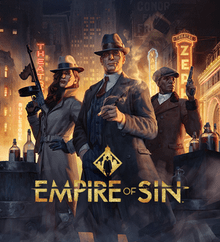
Empire of Sin is just about as far outside John Romero’s wheelhouse as he could have ventured.
The father of first person shooters will always be known for his work on Doom and Quake at id Software. What Romero does best (with the exception of Daikatana) are dark first-person shooters with an emphasis on speed and mobility.
So when Paradox Interactive announced they were publishing a Romero Games-developed strategy game where you play as a prohibition-era mob boss, it put the gaming industry on notice. Although this was far from Romero’s work outside the first-person shooter genre (hello, Gunman Taco Truck), it was his largest.
People don’t like this game.
Critics generally found the game confusing with the various moving pieces, and they were unfavorable towards a combat system that occasionally felt monotonous. After a few years on the market, fans and critics generally agreed that the game was mediocre.
For a young, pre-journalism-career Wade and his brothers, however, it looked stunning. It was the first game I ever pre-ordered a game and it was my first M-rated game I bought with my own money.
Odd choice, I know.
But as I have mentioned, my parents were very against M-rated games and still do not like them very much to this day. I could couch Empire of Sin as an immersive experience for history buffs, and the game just looked flat-out cool in the trailers.
I think we were expecting a more action-packed game given that it was about 20s gangsters. I was a high schooler at the time, I wasn’t cultured enough to enjoy strategy games. But I recently came across the game again, and I really did fall in love. I never really stopped being a history buff, and it was fun immersing myself in a gangster playground.
I decided to take an in-depth look at the game and revisit Empire of Sin all these years later.
Gameplay: Minor Strength
As reviewers were quick to point out at the time, Empire of Sin borrows very heavily from the XCOM franchise in terms of gameplay. Granted, the turn-based combat across an open area works out nicely for what Empire of Sin is looking to achieve, but it is far from original. The addition to the XCOM gameplay that Empire of Sin adds is business management and territory expansion, which also is nothing new.
The creativity in Empire of Sin‘s gameplay lies in combining two seemingly non-complimentary gameplay systems into one. The problem is that players have to be a fan of both XCOM-style turn-based combat and business management simulators in order to really buy into what Empire of Sin has to offer.
I spent some time trying to come up with some ways to improve the gameplay, but all I could really think of involved moving the camera (and we will be revisiting the camera a few times throughout this review). Overall, the way the player controls the game does add to the experience, making the seedy underbelly of Chicago feel like a sinister chessboard. It has its flaws, but the developers really did land on the most effective control scheme.
Presentation: Strength
Hear me out.
Yes, there are a lot of menus. Yes, there are a lot of subscreens. Yes, there are a ton of things to keep track of throughout the game. But Romero Games compiled every element of the game in the most streamlined, efficient and visually appealing way possible.
The organization of the game’s elements feel intuitive once you go through the tutorial, and even if you forget exactly where to find the thing you are looking for, it is fairly easy to figure out what to click to get to the desired subscreen.
My favorite part about the presentation is the world map. The game allows you to pull back the camera into a simplified neighborhood map, where the player can see at a glance what rackets are in play, who owns those rackets, where those racket bosses are, what they are doing, etc. It makes the amount of real time information the player needs to take in far less overwhelming.
The only gripe about the presentation is the camera angle and it’s detriment to the art style. When following your crew on the street, you get a top-down view of the street, obscuring the view of the buildings and overall setting. Granted, any other camera angle would be irritating, given that you have to click on different parts of the street in order to move your characters, but I still would have liked an optional cinematic mode like in Red Dead Redemption II so you can observe the environment as you move.
Narrative and Storytelling: Minor Weakness
For a game set in such a romanticized time period, Empire of Sin is fairly underwhelming in terms of narrative.
The worldbuilding constructed by the rival bosses and side quest characters do not contribute much to the 1920s Chicago backdrop. The dialogue between characters attempts to read like authentic 20s working class lingo, but falls into a bit of an uncanny valley where the diction falls just short of realistic and is thereby completely unconvincing.
There was never really a point in the game where the writing felt flat-out bad, but I always felt that the nature of the game deserved more. In short, it’s not that I was unsatisfied with the narrative that was in the game, I was unsatisfied with the narrative that wasn’t in the game but probably could have been.
This is really a minor weakness because as a game with an iconic historical setting, the player is expected to be somewhat familiar with the “plot.” Al Capone has been an iconic figure for over a century, maybe even the most famous criminal in human history, so there is not much to add to his story. Even lesser known bosses such as Angelo Genna and Frank Ragen are rich historical figures who established their “characters” in real life during Prohibition. I just wish that the game had done more to give life to these real-life mobsters, making them feel alive and authentic in-game.
Art and Soundtrack: Strength
The art of Empire of Sin is fine. I feel the same way about the art style as I do the narrative. The soundtrack, however, is an absolute slam dunk.
Throughout the game, jazzy 20s-style music sets the mood for whatever the player is doing at the time. Walking around the map gets you smooth upbeat jazz, getting into a battle triggers a quick beat in a minor key and a sit-down with another boss gets you ominous saxophone. Frankly, the soundtrack does more to immerse the player in the setting than any other element of the game.
While I can of course appreciate the original score composer Tommy Buckley put together for the game, I do wish some 20s classics made their way into the game. Maybe modern audiences wouldn’t recognize them (myself included, truthfully) but it would still be a nice touch.
Going back to the visuals, they’re decent but ultimately unmemorable. The character designs seem period accurate, and the models don’t look bad. I mentioned that the camera angle does not do justice to the buildings and set pieces, which is a shame because they do sell the 20s Chicago setting well. But from memory I cannot recall a single building model; they just all blend together in my mind. In some ways that is the mark of a successful visual setting, not taking away from the gameplay experience without sacrificing ambience. But given that the street views only occur while moving from one place to another, I would have liked something more memorable to look at.
Replayability: Neutral
It is very difficult to experience everything the game has to offer in just one playthrough, which lasts from 1920 to the repeal of the Volstead Act in 1933. The time constraint forces the player to be very intentional about their choices as they forge their own path, similar to Civilization. So the replayability of Empire of Sin derives from making different choices in each playthrough.
The issue is that there is not much major variation between playthroughs. You can play as different historical mob leaders, and they do have different characteristics and attributes and what have you, but most replays are going to feel about the same. It is unlike Civilization where playing as different leaders gives you access to significantly different abilities and resources.
That said, even with a lack of variation, there is still value in repeating the adventure. It becomes almost like a high score-based game, trying to outdo yourself in terms of Chicago domination. It certainly does not detract from the game’s quality, though the replay value is definitely not showing up as a bullet point on the back of the box either.
Empire of Sin is a flawed game, but a brilliant experience. It stands to reason that the game never won any awards, but it is undeniably entertaining to boot up every now and again and live out your gangster fantasies. That’s the beauty of video games: you can brutally rule South Side with an iron fist, crushing anybody in your path and looking down upon your trembling rivals, and in the next instant you can get up from your computer and go do your normal nonviolent job. It’s cathartic in a way. People do not play video games for catharsis alone, but if that’s what you’re looking for one day, give Empire of Sin a chance.


 GAME WRECKS
Leave a comment