
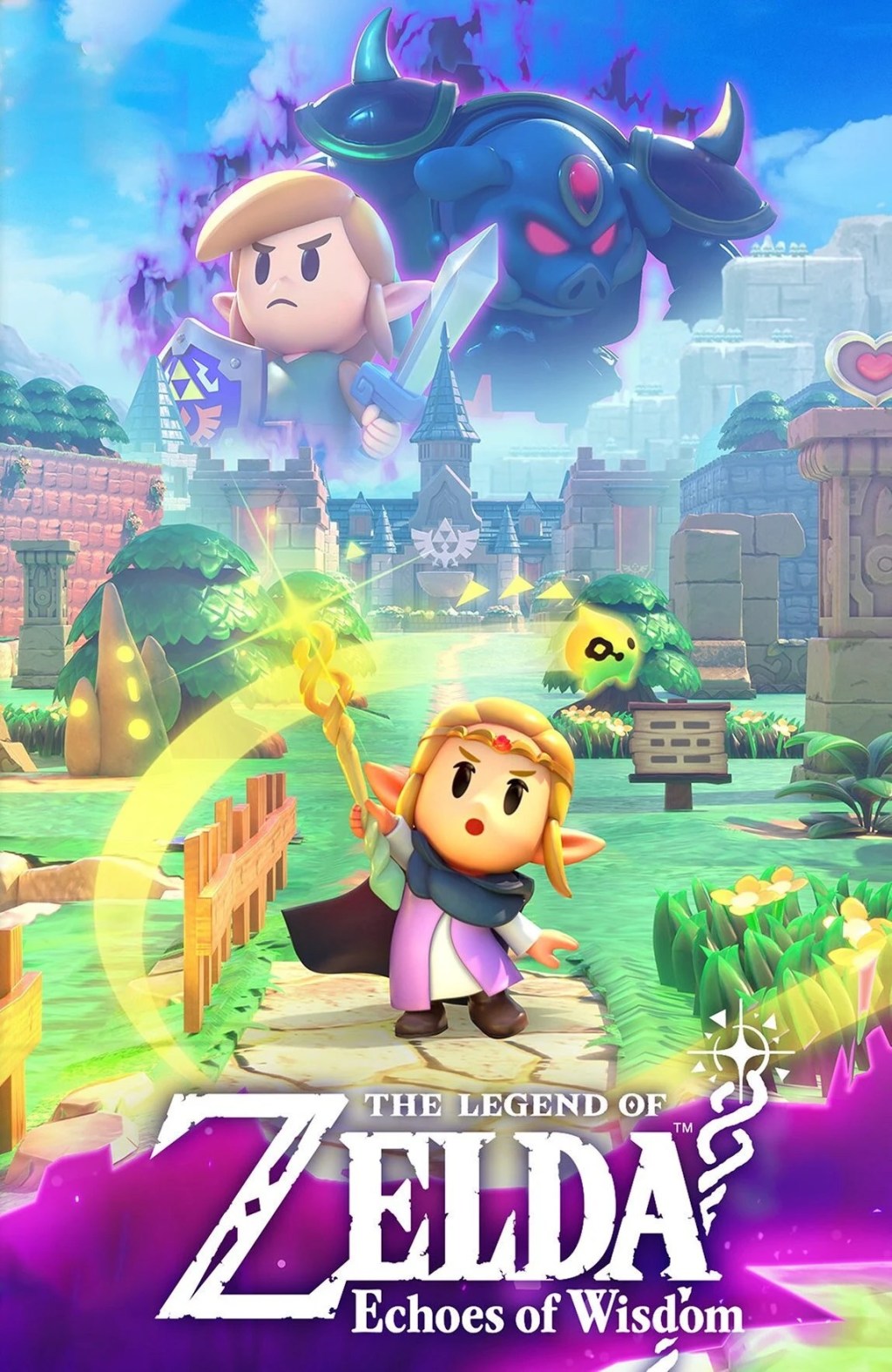
After a bit of an abrupt announcement, The Legend of Zelda: Echoes of Wisdom gave Switch owners the first ever Legend of Zelda game (that was developed by Nintendo) in which the player controls the titular character. Many critics were surprised that the Switch got a new mainline Legend of Zelda game with rumors of the console’s successor in full gear, assuming that the next game in the series would serve as a launch title.
Here are our thoughts on the merits of The Legend of Zelda: Echoes of Wisdom based on our five categories for adventure games.
Gameplay: Strength
Echoes of Wisdom is far and away the most unique Legend of Zelda game in terms of gameplay.
The entire gameplay system revolves around the ability to summon objects and creatures to traverse the world and battle monsters. Certain objects have a gold glimmer around them, indicating that Zelda can point her Tri Rod at it and store it as an echo. Additionally, any non-boss enemy that the player defeats becomes available for Zelda to copy and later summon to fight on her behalf.
No other Legend of Zelda game (ironically with the possible exception of Zelda’s Adventure) has less direct combat with enemy entities, though that does not mean combat is nonexistent. With the way the player must choose a combatant and watch as the fight between the echo and enemy takes place, the combat system feels more like that from an RPG than an adventure game. It’s not necessarily a bad thing, though, and injects more strategy into combat than most Legend of Zelda games.
What Echoes of Wisdom‘s side quests lack in length and complexity they make up for in number. At any populated point in the game world there are four or five side quests waiting for you, although they mostly consist of finding an item for an NPC. The rupee rewards are fairly generous, although the reward for a quest is a food item just as often as it is money. That is not to say that there are never any unique items you can receive from side quests that help the player throughout the rest of the game, but those are very few and far between. Granted, that rarity prevents Zelda from becoming too overpowered, but it sometimes feels a bit disheartening to get an item you could have gotten from destroying grass and plants, even if it is at a greater quantity.
As much as I tend to prefer a moderate challenge to an extreme one, Echoes of Wisdom‘s overly easy difficulty suppresses the strength of the gameplay as a whole. I had played the game for over five hours before I lost all of my hearts even once, and I was particularly surprised when I fell into a chasm in a dungeon, only to respawn next to the chasm having lost none of my health. In any other Legend of Zelda game, such clumsiness would result in a half-heart penalty, but even in Hero difficulty there is no punishment for leaping into pits in Echoes of Wisdom. That particular example is a symptom of a larger problem, that being sacrificing some challenge for the sake of appealing to a younger audience.
Presentation: Weakness
There are far too many visual hiccups for a first party Nintendo game. Characters snapping out of existence as they approach a doorway, creature pathfinding being borderline suicidal and monsters getting stuck in rocks are all regular occurrences peppered throughout Echoes of Wisdom. It takes away from the immersion in cutscenes and can even make combat sections, particularly in the 2D sections of dungeons, a bit messy.
Additionally, the echo management in the game needs work to say the least. Selecting an echo in Echoes of Wisdom works in a similar way to selecting a weapon in Breath of the Wild, in that the player holds down a button on the D-Pad and then uses the right stick to scroll through the echoes until they find the one they want to load into the active slot.
The problem is that the intrepid explorer will collect around 30 echoes by the time they’re halfway through the game. It is helpful that the echoes are automatically sorted to have the most recently used ones at the beginning of the list, but that makes finding that one echo with the extremely specific use case very difficult when you finally need it. You can choose to sort the echoes in other ways, but in the default sorting method the order of echoes is always changing, making keeping track of their locations in the list difficult.
Echoes of Wisdom borrows most of the elements of its menu system from Tears of the Kingdom (and by extension Breath of the Wild), and that self-plagiarism turned out to be a great decision. Legend of Zelda fans are already familiar with this menu system, making any use of it fast and intuitive. Even if Echoes of Wisdom is the player’s first Zelda game, that menu system is very easy to learn and does not bog down gameplay in any way. But good menus do not a good game make, and this one good presentation decision does not excuse the other rough edges in the game.
Story: Neutral
I am of the opinion that any Legend of Zelda game has the potential to be a potent storytelling vessel. I think of Link’s Awakening, where the player starts to question if what they are doing is really heroic, balancing self preservation with utilitarian desire to preserve the island’s inhabitants. I think of Ocarina of Time, where the player accompanies the brave little outcast as he seeks to prevent the very timeline he finds himself in (also containing one of the first great plot twists which I refuse to spoil). I think of The Wind Waker, where a pirate captain must uncover her true identity to save the world and a king must perform the ultimate selfless act, all while our cell-shaded protagonist goes on an epic quest to save his sister. In short, the very nature of any Legend of Zelda game imbues it with the capacity for a compelling narrative.
Echoes of Wisdom‘s story is just okay.
The synopsis is not much different than Wand of Gamelon in that this time, Zelda must save link. Actually, she is tasked with saving lots of characters as they get swallowed up by rifts popping up around Hyrule, but other than that it is the same.
Sure, the plot is serviceable to sustain and justify the gameplay, but it feels as though the game’s creators thought of the echo mechanic first and then later built a plot to support it. Even the rifts don’t feel original, especially being the next original Legend of Zelda game after Tears of the Kingdom, which had multiple pits of Gloom leading to The Depths. Even before that, A Link Between Worlds felt like it did rifts better than Echoes of Wisdom did, allowing the player to interact with them more without making them any less significant plot devices.
I did not particularly dislike any character, but at the same time none of the characters were very gripping. No characters were particularly funny or charming like Ravio in the aforementioned A Link Between Worlds, no dynamic characters on the path to redemption like Groose in Skyward Sword and no tragic characters such as Midna in Twilight Princess. Frankly, I would have even taken an insufferable narcissist such as Revali in Breath of the Wild over the static, bland characters we got instead.
That said, there were no characters in the story that actively detracted from the game, with one exception. The dialogue for Zelda’s floating orb sidekick Tri was apparently written by Captain Obvious. Any time Echoes of Wisdom attempts to invoke even a hint of subtlety or allows the player to piece together a new development in the story, there’s Tri to hover in front of Zelda and explain what the player just saw and what it means, diminishing whatever sense of accomplishment the player derived from figuring it out on their own. The only explanation I can think of for this behavior is that because Echoes of Wisdom is meant to be accessible for a younger audience, Tri is there to make sure younger players are not confused or left behind in the plot. But then again, Link’s Awakening was also made for a wide age range, and every iteration of that game was far more clever with the way it clued the younger players in on the big secret of the game. So while I understand what Tri contributes to Echoes of Wisdom, it is still a poorly executed character.
Other than Tri, every character does their job in advancing the plot in the service of gameplay. The story as a whole supplements the player’s quest rather than drives it, but it is also not something worthy of cringing or eye rolling either. It just statically exists. In other words, it is just okay.
Art and Score: Major Strength
I mean, come on, just look at it.
Echoes of Wisdom is a visual treat. Much like Link’s Awakening HD, the enhanced lighting compliments the unique character design perfectly, and despite a complete lack of photorealistic anything in the game, the characters and set pieces almost look like toys come to life, which is perfect considering the audience Nintendo was looking to capture.
One of the most striking parts of the game for me was the way the designers transposed existing Legend of Zelda character tropes into this unique art style. For example, in order to convey a Gerudo warrior in this art style, the artists selected the most defining aspects of a Gerudo warrior’s garb, simplified it for a smaller character model, and then accentuated it to give the Gerudo their own strong visual identity.
A smaller challenge that the artists tackled brilliantly was differentiating between different members of the same tribes. Going back to the Gerudo example, the artists differentiated the Gerudo chief by giving her larger hair and a different style of facemask, and differentiated the captain of the Gerudo guard from the rest of the warriors in a similar way. It might not sound impressive at first, but bear in mind that the designers had few details they could manipulate, and they had to think about how to visually convey power without the ability to drastically alter character design, lest they risk making it unclear whether that character belongs to the same tribe.
The soundtrack imitates the style of Link’s Awakening HD and does borrow some musical sound hits, but the musical score in Echoes of Wisdom‘s overall bouncy mood sets the tone for a lighthearted adventure. The game uses original environmental background music which leans more into the flute as opposed to Link’s Awakening HD‘s violin-heavy score.
Replayability: Strength
For many of the challenges in Echoes of Wisdom, there is no one way to solve the problem. Sure, there are numerous obstacles which can be overcome by stacking a bunch of echoes on top of each other and climbing up the makeshift scaffolding, but there are at least an equal amount which require some thought and creativity. Each replay of the game offers a new way to interact with the more challenging puzzles.
As mentioned previously, though the side quests are short, they are numerous, and they do provide additional challenge for a player looking to do a 100% run of the game, even if it is mostly for their quantity. That said, players will mainly derive replay value from solving the same main challenges they’ve overcome in different ways, including some challenges posed in side quest missions.
Final Thoughts
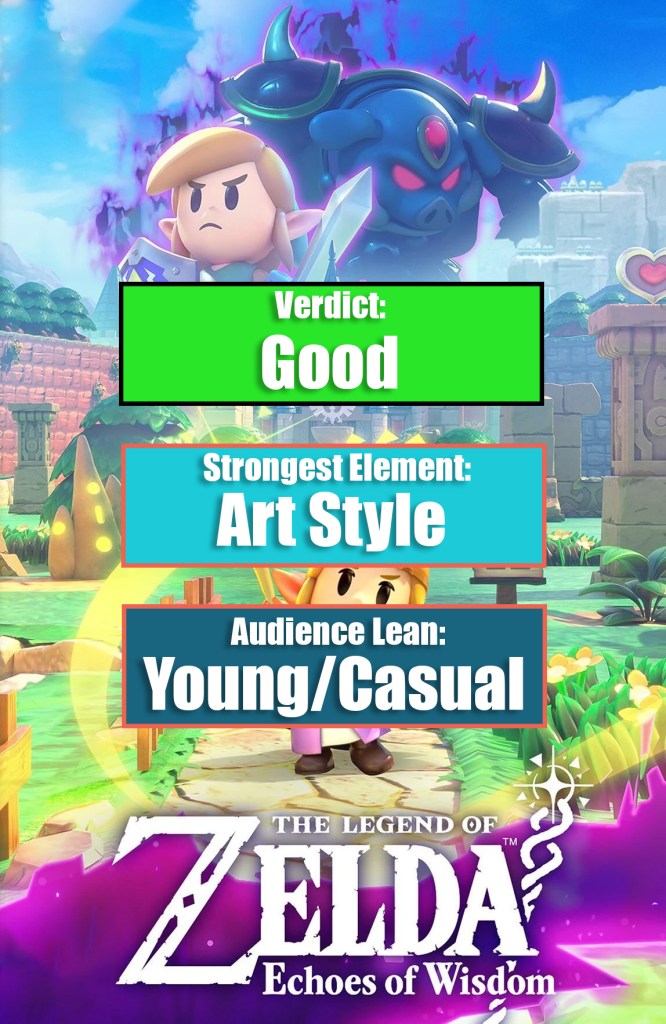
Echoes of Wisdom is the perfect game for a more casual gamer, particularly of the younger variety, who is familiar with the Legend of Zelda franchise and is open to trying a different variation of the standard formula. Fans of the Legend of Zelda franchise as a whole should consider picking up a copy even knowing some of the drawbacks of the game. It might, however, not be a good purchase for a gamer looking for a story rich experience as their next game.


 GAME WRECKS
Leave a comment